

Precision or Paralysis: ROI for Female Founders
Precision and accuracy have meaningful differences that impact your business. For underfunded female founders and women-in-business, precision matters. You can be precise and wrong — hitting the same spot over and over, confidently, nowhere near the target. You can be accurate and inconsistent — landing near the truth of a measurement sometimes, missing it wildly other times. Since women in business receive less than 2% of venture capital annually, we have to be precise. Read more at www.KellieAdkins.com/new-blogs
There I am in Chemistry class listening to the professor lecturing on measurement (an essential skill for any budding chemist). The lecture turned to a critical distinction between precision and accuracy. Surely I had heard this lecture before. But this time I heard it. And it gave me a new way to evaluate my own individual efforts, which allowed my perfectionistic, striving, self a little grace.
I was in the first year of “catch up” courses on a pathway I believed ended with a PhD in Neuroscience. After living abroad the year prior, and changing my major from Biology to Religions the years prior to that, I was swimming in a sea of self-doubt and anachronistic longings.
What if I had stuck it out in (third year) Genetics as a first-year?
What if I had trusted my mind enough to tackle Calculus earlier?
Why didn’t I complete a second thesis to graduate with both a B.A. and a B.S.? I had done all the coursework!
Why didn’t I go to Nepal after college to study with Buddhist nuns like I planned?
Mostly: WTAF was I doing back in my hometown?
Back to the lecture:
“Precision and accuracy get used interchangeably in everyday language, but in chemistry they measure two different things entirely,” the professor says.
Accuracy is how close a measurement lands to the true value.
Precision is how consistently repeated measurements land in the same place, regardless of whether that place is correct.
You can be precise and wrong — hitting the same spot over and over, confidently, nowhere near the target.
You can be accurate and inconsistent — landing near the truth of a measurement sometimes, missing it wildly other times. The goal is both at once: tight grouping, centered on what's actually real.
This is the distinction that gutted me in that college Chemistry course. And one that I think women-in-business need to sit with, because most business (and life) advice sold to us conflates the two.
"Trust the process" is often an accuracy claim with no precision behind it. That message gets you going in a general direction with no method for consistently getting there.
"Hustle harder" is a precision instruction with no accuracy check. That message tells you to repeat effort without verifying you're aimed at the right target.
Repetitive effort without verifying your targeted goal isn’t a strategy–it’s a recipe for disaster.
These slogans are marketed as solutions, when, in fact, they overlook the structural and systemic forces that challenge female-and-femme-led enterprises.
These sycophantic simplifications wear different clothes depending on who’s presenting them as solutions. Sometimes, they’re all dolled up with a side of spirituality (I’ll see your “manifesting blueprint” and raise you a “cosmic-realignment of your energy centers”). Other times, these are packaged up in sleek suits accompanied by overblown exaggerations (“Go from six-to-seven figures with my eight-point mindset map for your business”).
If you’ve been in business (especially online-adjacent) business for any length of time, you’ve seen the yucky tactics, you’ve probably slipped down one of those marketing funnels, and maybe you fell into the sticky web of contradictory platitudes telling you to “Do more, charge more, be more,” and also “Do less, don’t chase, just attract” and then, “Your bank account is up to you” but also, “You are not your bank account” and ….I could go on….but ….
The data below are my accuracy check and will drill this point home; I’ll let the data speak so this piece is grounded in what's true, not just my whiny gut-check on an exploitative, gendered power differential in business (and business advice).
Keep the Numbers (Save the Spin)
I’m guessing y’all have sat through enough breathless pitches and “But, wait!”-filled on-demand “trainings” to know the difference between a claim and a citation. I lead with data to flesh out the problem — including the parts that complicate a tidy narrative.
these data are drawn from US sources, so they are implictlly limited as such.
I’m using “women” because the data on LGBTQIA+ and femme-led enterprises are difficult to find at scale.
“Women” is itself a blended category: Single women? Married women? Black women? White women? Immigrant women? Minority women? Women who are mothers? Women who are caregivers? This category is just one “bucket” in which the data are collated. I’m not putting every woman in the same category —but the data do. In order to have better solutions, we need to articulate the problems better: that begins with better data.
Having said all that, here is what the data show.
Women are building at pace.
It’s no longer about ownership…
Women now own roughly 14.2 to 15.7 million businesses in the U.S. — depending on whether you use Census or Wells Fargo's count — generating between $2.8 and $3.3 trillion in annual revenue (Corp! Magazine, The Broker Shop). Between 2022 and 2025, women-owned firms grew 12.1% — outpacing male-owned firms. Solo, non-employer businesses owned by women grew 62.2% faster than their male-owned counterparts over the same span.
What those data don’t show is the precision problem inside of that growth: in spite of owning roughly 40% of all U.S. businesses, women-owned firms hold only 9–9.6% of total business employment and just 4.6–6.2% of total business revenue.
Men own 2.6 times more employer businesses than women, employ four times as many workers, and generate 7.4 times more revenue (Wells Fargo Impact Report, via Corp! Magazine).
Women are not scaling at parity.
…It’s about scaling.
We are starting at parity–or at least catching up— but not scaling at the same level. This gap isn't explained by ambition, acumen, or ability; the volume of new businesses proves women-in-business have that in abundance. The scaling gap is explained by structure; most women-owned businesses stay solo and self-funded, which caps growth by design, not by choice.
Venture capital data shows the same pattern in sharper relief.
2025 was widely reported as a record year: female-founded companies raised $73.6 billion, capturing 27.7% of total U.S. VC deal value for the first time (PitchBook, via Fortune).
Peek beneath the hood of that headline, and the truth of those numbers will give you pause.
Two-thirds of that $73.6 billion went into AI. More than $30 billion of it landed at exactly two companies — Anthropic and Scale AI — both counted as "female-founded" because a woman sits on a mixed-gender founding team, not because a woman is the sole founder (Fortune).
Women are (still) underfunded.
When you remove the two outliers above, the "record year" framing changes substantially.
For companies founded solely by women, the number is 1.1% of all VC capital deployed in 2025, down from 2.1% the year before (PitchBook–NVCA Venture Monitor). Deal count for all-women teams hit its lowest level since 2018.
Nearly 79% of first-time VC financings in 2025 went exclusively to all-male teams. Only six new women-led VC firms launched in 2025 — the fewest since 2011 — and capital raised by women-led funds fell 37% year over year.
Women-owned companies are more profitable to investors
Here's the finding that should reframe the whole conversation: research cited across multiple 2025–2026 industry analyses, sourced to Boston Consulting Group, found that women-founded companies generate 78 cents of revenue for every dollar invested, compared to 31 cents for male-founded companies (Femfounded).
I want you to read that last sentence again. See where it lands in your body –especially if you are a female-led business owner.
We (women-owned enterprises) are the most capital-efficient investment by a factor of more than two — and we receive capital like a rounding error.
That's not a performance gap. It's an allocation choice being made by people who control access to capital, and it long predates any of us individually walking into a room asking for funding.
Before the funding conversation even starts, the wage gap already shapes what capital women can self-generate.
Women (still) earn less than men
I know the headline isn’t a shocker, but… shit. In the first quarter of 2026, women's median weekly earnings were $1,098 versus $1,362 for men — 80.6% of the male median (U.S. Bureau of Labor Statistics). For Black and Hispanic women, the gap compounds: Black women's median earnings were 85.4% of white women's, and Hispanic women's were 80.5% of white women's (BLS). For BIPOC women, credit access compounds it further — 73% report that getting a loan was somewhat to very difficult, and 45% of BIPOC applicants have never been approved for one, compared to 36% of white women (Wells Fargo, via Bizwomen). I’ve written on this topic before, including practical strategies for women in business to earn more.
What Gives? Or, What’s Actually Blocking Us
None of this is happening in a vacuum, and it isn't happening because women are worse at business. It's happening inside specific, documented structures, and precision requires naming them plainly.
Unpaid Care Work
The invisible labor tax runs before the business day even starts. Care work — childcare, eldercare, household management — is disproportionately unpaid and disproportionately performed by women, and it is excluded from GDP entirely because standard economic measurement wasn't built to count it (UNDP). In the U.S. alone, unpaid caregiving is valued at more than $1 trillion annually, with women providing $643 billion of that value (National Partnership for Women & Families, BLS American Time Use Survey). Globally, Oxfam estimates the value of women's unpaid labor at $10.9 trillion a year — more than the combined revenue of the fifty largest companies in the world (New York Times / Oxfam). This is the hidden ledger entry nobody puts on a pitch deck: the hours a founder has already worked before she opens her laptop, subsidizing an economy that doesn't record the transaction.
When people tell you money makes the world go ‘round….LOL in their face. Women’s love and (unpaid) labor makes the world go ‘round, hon. Since the dawn of f’n time (and we women are tired).
One Generation Deep
This capital gap is not ancient history (though it is the foundation HIS-story)— it's one generation deep.
Women in the U.S. could not open a credit card in their own name, independent of a husband's signature, until the Equal Credit Opportunity Act passed in 1974 (Forbes Advisor). That means the first generation of American women to build independent credit history, and therefore independent access to business capital, is only now reaching the years where that capital would typically compound into real intergenerational wealth. We are not behind because of some innate gap in financial capability. We are early in a structural transition that men have had roughly two more centuries to compound inside. Naming that isn't an excuse; it's the actual timeline, and it changes what "catching up" should reasonably look like.
Women’s Industries (still) Undervalued
And the industries where women concentrate get valued differently by the same market.
Wellness, caregiving, education, coaching, "soft" service work — the fields where women-owned businesses cluster — are structurally undercapitalized relative to their economic footprint, in part because capital markets have historically treated "women's work" as inherently lower-margin, harder to scale, and less fundable, independent of the actual unit economics (UNDP). That's not a market signal. It's a blind spot with a balance sheet.
Put together: an invisible labor tax before the workday starts, one generation of independent credit history, and a capital market that structurally undervalues the industries women build in.
That's the reality and like many Both/Ands, the avenues to deal with it are contradictory. Because, none of the above are good reasons to stay small. In fact, they are the exact (dare I say, precise) reasons precision matters more for women in business than it does for someone else (read: men).
Precision Packs an Exponential Punch
Precision’s operating principle reads like a manifesto: if the system isn't allocating capital at parity (and that’s what the data show), then the resources you already control have to be deployed with more precision than someone some man building from a funded position and cushioned platform.
Precision means staying lean.
Precision requires naming to yourself when you're in "figure it out" mode versus "execute a known method" mode. Precision requires you to understand those modes–and to meet them with completely different resources.
Precision will save you time, but it means asking someone who has already solved the specific problem you're circling, instead of re-creating an answer independently. (I know, I bristled at that last sentence, too. I’m an eldest daughter –being independent is in my DNA. Asking for help?!? Who do you think I am?)
If some part of you still believes that “Struggle” = “Deserving” and “Isolation” = “ Strength” then please, for all that is good and holy, let those limiting beliefs go right now. Sometimes struggle is just struggle and isolation is just isolation.
The hard truth in business is that the faster you close the gap between where you are and how to get where you want to be (by asking someone who's already solved your exact problem), the faster you’ll get there. In between, you’ll have less burnout. This is why well-funded businesses get there– wherever they’re going– faster. Money is an excellent problem-solver.
Honesty Checkpoint: The Coaching Industry
If you’re thinking this is where I pitch you on my coaching: it isn’t (yet). I won’t insult your intelligence by handing you flattering statistics about coaching ROIs without context. If I only quoted the widely cited 5x–7x ROI figures from the International Coaching Federation and MetrixGlobal without naming that those numbers come largely from people who already believed in coaching before they paid for it, I'd be doing exactly what undercapitalizes trust in this whole category.
A 2018 Harvard Business Publishing survey found that only about a third of business leaders reported being meaningfully more effective after a coaching or leadership program (Harvard Business Review). And, most masterminds underdeliver for reasons that have nothing to do with the strategy taught inside them: no real screening for fit, no group accountability, no ongoing feedback loop, facilitators who either overcontrol the room or disappear from it entirely (11 Reasons Mastermind Groups Fail).
The honesty checkpoint is that coaching and cohort work produce real ROI when the structure itself is, well, precise. That looks like a deliberate screening process, well-defined accountability, a coach or self-aware facilitator who can practice presence and build community, and a clear outcome instead of open-ended promises. Those decisions are educational design standards that have nothing to do with marketing (unless you practice trust-based marketing *raises hand*).
A Question without an Answer
So here's where I'll leave this, at least for today: what do we actually do about it?
Not the mindset version of that question — I'm not interested in convincing you to feel differently about a funding gap measured in trillions of dollars and a legal timeline that only started in 1974.
I mean the structural version.
If the invisible labor tax, the capital gap, and the undervaluing of "women's work" industries are the terrain, what does a business actually built for that terrain look like?
What does precision — not more hustle, not more trust-the-process — require in practice, for someone starting later, funded less, and carrying more unpaid weight than the data assumes she's carrying?
I have real thoughts on this. I've spent the last several years building specific answers to it — the Wisdom Method Business Incubator and my book + corresponding course, the Purpose and Prosperity Project (I promise I’ll share more about both soon).
For now, I'm curious: how do you fill this gap yourself? Do you have your own version of precision: a method, a structural fix, or a decision framework that got you out of figure-it-out mode? I’d love to know. Reply, if you’re willing to share your thoughts. I read every comment and reply.
Sources:
U.S. Bureau of Labor Statistics, Median weekly earnings $1,098 for women, $1,362 for men, first quarter 2026
U.S. Bureau of Labor Statistics, Highlights of Women's Earnings in 2024
Wells Fargo, "The Impact of Women-Owned Businesses" (2026), via Corp! Magazine and The Broker Shop
PitchBook, "US All In: Female Founders in the VC Ecosystem," via Fortune and LinkedIn/Joanna McGinley
Boston Consulting Group revenue-efficiency research, via Femfounded
Wells Fargo, "State of Women's Small Business," via Bizwomen
National Partnership for Women & Families, Unpaid Care Work Analysis (BLS American Time Use Survey)
UNDP, Valuing Women's Unrecognized Contribution to the Economy
The New York Times / Oxfam, Women's Unpaid Labor Is Worth $10,900,000,000,000
Forbes Advisor, History of Women and Credit Cards: 1970s to Present
Harvard Business Review, 2018 State of Leadership Development
Damian Mark Smyth, 11 Reasons Why Mastermind Groups Are Doomed to Fail

AI Policy + Use
I’m being transparent about my process and my AI usage — where it shows up, where it absolutely does not, and how, exactly, I use the medium. Learn more about how I employ AI at www.KellieAdkins.com/new-blogs
I use AI in my process from thought to page in my public-facing posts and blogs on this website.
Mostly, that looks like transcribing my audio notes (on the front end) and adding keywords and SEO optimization (at the back end). Very rarely, I use AI to generate images like the one above.
I do not use AI to write or compose my work, to write or compose my social media posts, or to write or compose my articles. Likewise, all comments or messages coming from my social accounts are me —or an actual support team member.
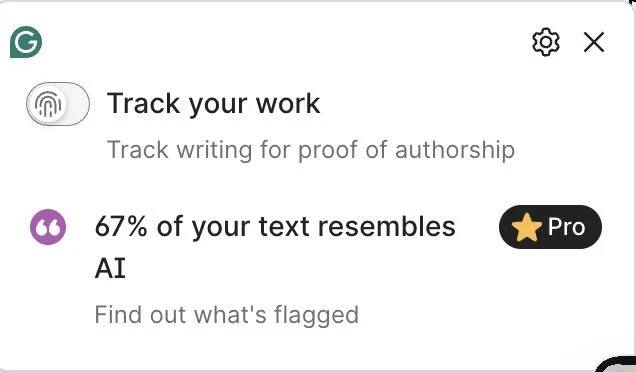
Even so, most of my work is flagged as AI-generated (see below, with timestamps showing when the original work was created).
I have thoughts about why that is:
First, I was trained in academic writing and am a student of philosophy; thus, “if [this], then [that]” construction is hard-wired into my thinking and writing process.
Next, for context, as a youth, my preferred author was Edgar Allan Poe (famously verbose with an astonishingly rich and emotionally evocative vocabulary), and I challenged myself to expand my vocabulary in a similar style. [Stephen King’s On Writing later shape-shifted my particularly verbose writing style—with dubious efficacy, as this list evidences].
Then, I am trained in a particular style of ontological inquiry that involves intensive visualizations, layered mind-maps, and a rigorous system of logical and philosophical tenets, generally organized by itemized, numbered, or mnemonic lists. The systematic organization of knowledge packets into digestible, preservable sound bites—for the purposes of memorization and retrieval—is built into my own intelligence: AND/ALSO superintelligence (computers, AI, LLMs) frameworks are designed to mimic this process. To put a fine point on it: the machine thinks like me because it was designed in the image of critical, logical thinkers. We had the same teachers. We use the same cognitive framework.
Also, I spent years writing on the internet (blogging since 2008); thus, I am part of the community of creatives whose collective works were stolen by the AI companies — they called this theft “training data.”
Next, I am a voracious reader. I know very few individuals who read as much (or as expansively) as do I and that isn’t a value statement; it’s a historical fact. I used to keep count of the books I’ve read. I stopped after reaching 10,000 (in high school). I’ve read 2-3 books every month since then —and no, I’m not telling you how long ago high school was! But I will tell you that I’ve had my nose buried in a book, or several, on the daily, since learning to read in 1985 (you do the math).
Lastly, I spent time working in tech— training the AI (LLM’s) we all now rely on. One cannot export one’s brain to the machine for as long as I did without it impacting both ways.
I use AI to assist with coding —then a human reviews the code.
I do not rely on AI for coding and data security. That is a human’s job.
I use AI to build back-end supports for my own purposes —not to run my business.
I do not use agentic AI to run the back end of my business. I’m picky about privacy, and don’t trust a bot to manage important or delicate details. That is a human’s job.
I do use AI to create mind maps of my business to share with possible collaborators (like this); to create writing assessment rubrics to ensure my writing fits my audience (I write curricula for a variety of audiences); to create tools for my clients to project their revenue in alternate business models (like this); to build scalable solutions to intractable problems in certain industries (like this); to build tools that solve public health problems disproportionately affecting women, children, and marginalized individuals (see below).
I use AI to build apps and virtual reality spaces to support survivors of trauma in their healing—then a human reviews the code.
I do not support, endorse, or enjoin outsourcing therapeutic work or relying on agentic AI to deliver therapeutic sessions. I do support the use of AI, or AI-created tools, to deliver in-the-moment resources or supportive tools between sessions.
I'm transparent about where I use the medium— and, just as importantly, where it never touches my work.
AI doesn’t touch my research meant for publication or my client’s sensitive information. Full stop.
AI doesn’t touch my emails, client conversations, or editing process (all typos, odd phrases, and dangling participles are my own). I’ve opted out of Gemini in my Google workspace and do not use Notion or AI transcription without explicit consent: if a client requests a transcription or recording of our calls, I first disclose that use of AI, then get their opt-in in advance.
When I do use AI, I use paid, enterprise-level tools with the strongest data privacy agreements currently available (they explicitly do not train on my data). Even then, I treat the medium like what it is: a very smart but inexperienced college freshman that makes a lot of mistakes and comes with deep biases and possible nefarious purposes.
Every idea, argument, and turn of phrase is mine. I built an accessible process, employing AI for transcription, product development, and online visibility because 1) I'm a verbal, nonlinear thinker, and 2) I used to pay for the work I now use enterprise-grade AI to do faster, and 3) because I think an honest answer to "did you use AI" deserves more than a “yes” or “no.”
Pictured below: a few receipts.
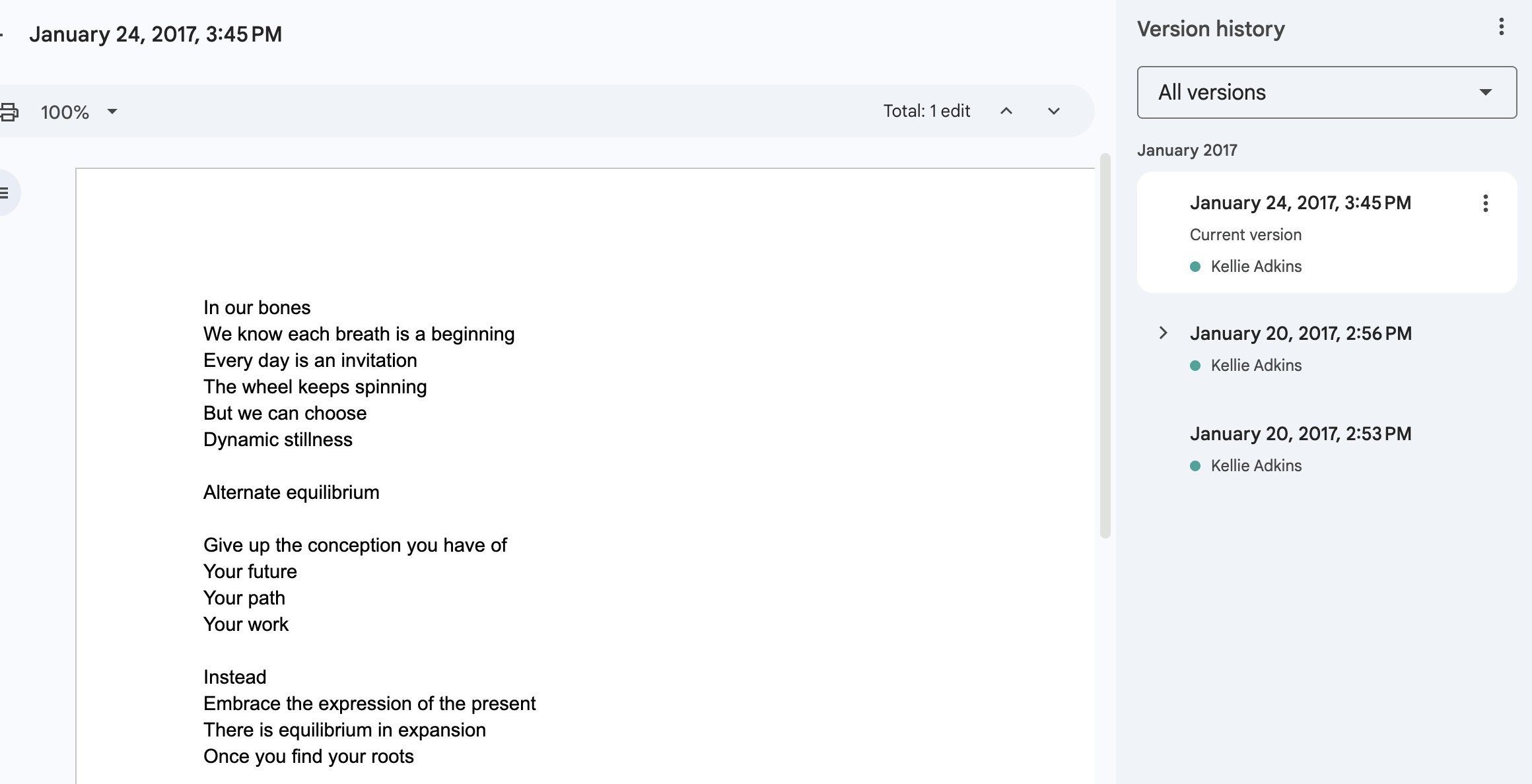
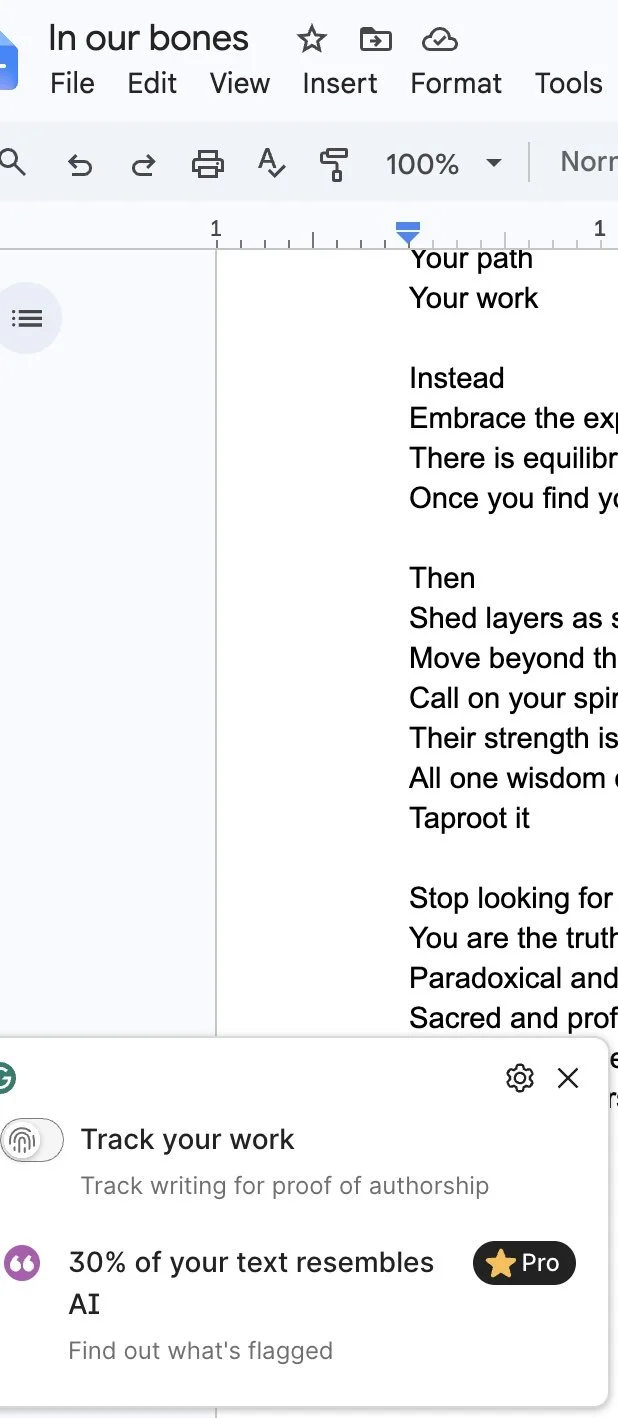
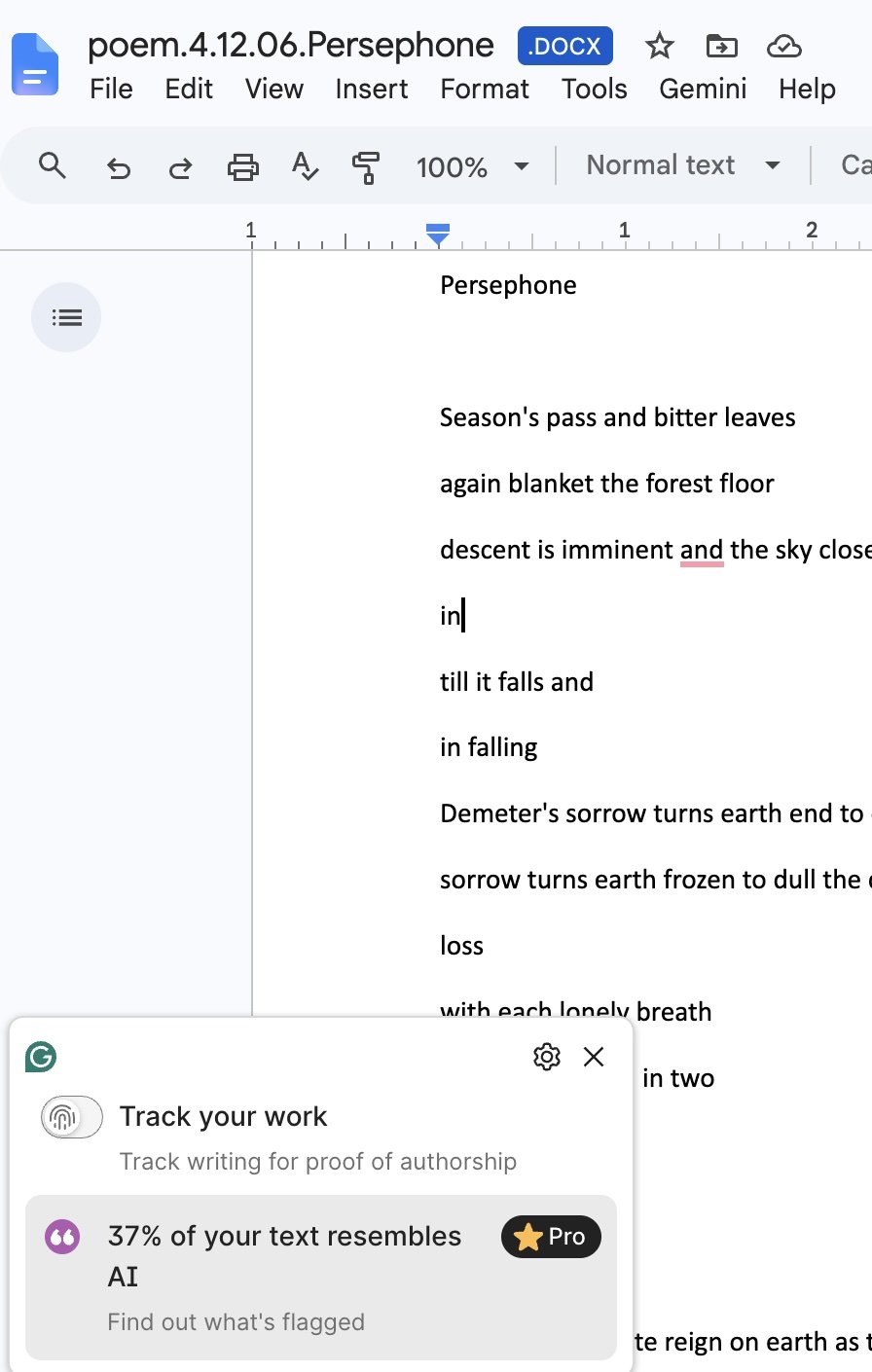
The image below refers to a essay I wrote for publication on Substack. I uploaded the first draft to a Google doc from the transcription. It was edited (by me) to read like a narrative, not a rambling voice note to the Universe.
No AI was used in the essay except for transcription from an audio note: it was flagged as 67% AI.

A Practice for Recalibration
Sometimes things feel off in business and life —when that happens, you need a practice for recalibration. Learn more about recalibrating your business/ life alignment. On the blog: www.KellieAdkins.com/new-blogs
I made you an audio if you’d prefer to listen here. (private link)
At the end of 2024, I realized I no longer identified as a "business coach." Not because I'd fallen out of love with the work—I still love helping people build their big business dreams. Something felt off: like a stuck gear or a slightly off-pitch guitar string. My gut was telling me to step back from the fray and find a way of working that made room for all of me.
I needed a recalibration.
If you've followed me since the early days from small-town health coach, yoga teacher and studio owner, travelling trainer and business coach, then you've noticed a non-linear career trajectory (with similar themes). But at one point in my life, I was singularly focused on my goal-oriented life trajectory: I was going to be a researcher.
My dream as a young girl was to work in a Think Tank, surrounded by people who were similarly committed to using intelligence, skill, logic, and creativity to solve the world’s most intractable problems.
Some of those intractable problems intersected with my own life these last few years, resulting in some communication gaps.
There are many reasons. A divorce. A cross-country move. Another cross-country move. A new baby. I gave you the bullet points, but not context.
My divorce was considered “high conflict,” entailing almost 7 years of frantic attempts (mine) to encourage resolution, repair, or at least a re-focus on the child involved.
As these interpersonal challenges crept further into my day-to-day life, I had to choose the kind of parent I wanted to be. The logistics of managing a complicated teaching and travel schedule as the Director and Lead Instructor of a training center proved untenable and impractical for my new life as a solo parent. My child needed my presence. So I prioritized their needs over my career.
As humans do, I adapted: I built online programs, centered my business on coaching, but in 2018 I temporarily shuttered my online business and training programs for a serious reason (stalking is real and dangerous).
Those years became a long search for a new path.
I found new forms of joy and new kinds of work: supporting mission-oriented organizations, providing fractional Co-CEO consulting for micro-enterprises, and working in the AI industry. Tech is an ideal industry for a solo parent crunching out work between school-drop off and pick-up— or at the “Toni Morrison” hours (before the light comes and the world wakes)—because the machine never sleeps.
My work in AI sparked renewed intellectual enthusiasm: paired with an equal amount of existential dread. Outsourcing my brain to the machine on the daily, along with so many others, gave me a glimpse into humanity’s trajectory.
It made me question everything (again). Yes, it is amazing and intoxicating and exciting and—if you’re obsessed with learning—the most exciting piece of technology ever to exist. But that still doesn’t answer the question: Why? To what end are we building?
To further exploit the most vulnerable?
To flatten our differences and become a homogenized summary of data points spit back to us in identical-sounding, if oddly worded, simulacra of cognition?
To collectively co-opt (read: steal) the intellectual property of every creator since the dawn of the internet age in order to re-package and sell back to us?
To outsource our most precious of human gifts —deep thinking and creativity— to a planet-destroying, water-guzzling, superpower that is the developmental equivalent of a toddler running with scissors? (a polymath MENSA-level toddler is still dangerous: arguably, more so).
Eventually, I could no longer handle the cognitive dissonance that left my nervous system wrecked and my mind restless with the implications of the tools I was helping to build.
To cope, I returned to a practice I call the 3 Rs: Reading, Releasing, and Reclaiming.
The first R: Reading
The first step is the most restorative. Reading things that move and inspire me is a genuine respite, and the more I read, the better I feel.
As I've grown older, there is less time for the reading I love most: poetry, spiritual texts, vintage knitting patterns, historical fiction, magical realism, biographies, YA sci-fi, scientific papers (I know. I’m strange).
Making reading a deliberate practice again—with a joyful rather than productive focus— improved my life immeasurably. It also served as a kind of brainwashing in the best possible way: like giving my brain a restorative slow dance in the rain.
The research backs this up.
A large study following nearly 20,000 middle-aged and older adults across 15 countries found leisure reading was prospectively associated with better health, well-being, daily functioning, lower cognitive impairment, and greater longevity. A 2024 evidence review on reading for pleasure reached the same conclusion: volitional reading is linked to meaningful gains in wellbeing alongside cognitive benefits.
The freeing part: genre matters far less than the habit. Graphic novels, children's books, home-decor magazines, vampire romances, the complete works of Vladimir Nabokov—the act of reading for pleasure carries the benefit. *Books appear to confer a particularly strong longevity advantage over newspapers and magazines, so lean toward books for the most benefit.
But the headline holds: Just read something.
The next two Rs: a dialectic within yourself
Releasing and Reclaiming work together.
Each begins with a single question:
What do I want or need to release?
What do I want or need to reclaim?
That's the whole practice. The tricky part is answering honestly. Ask the question, then let your intuitive self answer — the first thing that surfaces is usually the answer (the "why" is less important and often comes later).
After a few years of this practice, I noticed clear patterns.
Releasing, for me, usually shows up as something that drains my energy: mindless scrolling, obsessing over headlines, being less-than-present with my children, rumination, self-recrimination, complaining.
Reclaiming, for me, usually shows up as a nudge toward practices that restore or joys I’ve forgotten: a walk in the woods, my art-journal practice, morning pages, planting flowers, gratitude lists, reconnecting with a treasured friend, knitting a sweater, crafting a poem, playing the guitar. There is an untapped well of joy to be found in activities that challenge you just enough. And daily life is full of simple pleasures that oft go unnoticed and unclaimed.
There's a good reason this simple inventory works. Contemplative practices that build present-moment awareness are consistently linked to stronger emotion regulation — the capacity that lets you notice what depletes you and choose what refills you, instead of running on autopilot.
This type of self-inquiry is a virtuous circle of mutual emotional aid —self-care that is more than self-centered navel-gazing. Engaging in this type of contemplative inquiry creates the inner conditions that nourish mental health.
But it isn’t enough: if the contemplative practice is the rain, the social determinants of health are the soil. And research consistently shows that these factors far outweigh any mental health maintenance, emotional housekeeping, and self-work in action. This is an important distinction in a society that discounts the impact of its own dysfunctional systems on individuals and marginalized communities. Creating the conditions that nourish health begin at the structural and societal level. It is far too much to ask of any one individual.
Yet, the daily actions that nourish the conditions for mental health, emotional regulation, physical well-being exist in the literature and in one’s own ancestral line —if you exist, you’re living proof that your ancestors, despite all they endured, were survivors of the fittest caliber.
These practices are simple, not always accessible. That doesn’t mean they don’t matter or that we abandon those practices. For the sake of humanity, it’s time to double down on them.
Emotional regulation is violence prevention.
Social connection is addiction-prevention in practice.
Mindfulness is conflict resolution training.
And in an increasingly violent, disjointed, divided, polarized world, we need more people committed to modeling the best of humanity’s qualities: compassion, empathy, connection, creativity, care, insight.
When little girl Kellie envisioned working as a researcher in a Think Tank, this is what she thought the work would entail: humanity’s brightest and most diligent scholars, putting their heads together with care, compassion, and creativity to solve the world’s most intractable problems.
Now that I’m older, it’s clear that the initial spark of career aspiration was filtered through the rose-tinted lens of childhood: a childhood full of trauma, emotional neglect, and intellectual isolation.
Yet, the practices I’ve been drawn to over the years, the studies I’ve pursued, have been gently guiding me back to that original career aspiration.
An Inner Recalibration
I hope you’ll try the practice when next you need your own Inner Recalibration. I can't promise it will help you as much as it has helped me. But if you try it, will you let me know how it goes?
Read something.
Release something.
Reclaim something.
That's the whole practice — and it might just awaken the insight you've been too busy to hear (until now).
TL/DR
The 3 Rs — Reading, Releasing, Reclaiming — is a simple daily practice for awakening intuition
Reading for pleasure is linked to better well-being, cognition, and longevity.
Releasing and Reclaiming are practices that protect and restore a connection to your own insight, skills, forgotten strengths, and resourcing practices.
Contemplative awareness strengthens emotional regulation, resulting in better choices: for oneself and for the world.
Try the 3 Rs this week, then tell me what surfaced. I read every response.
Thanks for being here.
Break all the Business Rules...and Thrive?
Calling all Female Founders and Mindful Leaders: The rules don't apply for you because they were never meant to. You're a trailblazing change-maker who believes business is a vehicle for powerful good and world-changing ideas. Break the Business Rules to Thrive and join me in doing Business as Unusual | Kellie Adkins, Holistic Business Coach
Original art, Kellie Adkins
The “Rules” of business-as-usual say…
Work long hours
Hustle harder than everyone
Be everywhere on the internet
Market with sleazy high pressure tactics
Launch shoddy programs …
Then upsell when they don’t deliver results (cue the “from 6-to-7 figures expert advice”)
Sacrifice your talents to “prove your worth”
Undercharge for your services to “stay competitive”
Undercharge because you’re a woman/minority/neurodivergent in business
I don’t want to live (or run my business by) those rules anymore.
There are more important things to prioritize than hustle culture.
Democracy is being threatened around the world.
AI is coming for our jobs and affecting our brains.
Racism is experiencing a global resurgence.
Misogyny seems to be the new(again) standard.
A history of violence against women is no longer a barrier to nomination (or election) to the highest levels of government in the United States.
No longer is it gauche to attack someone based on their beliefs, racial identity, or gender: online or in person.
Which is why NOW is not the time to play by the rules: their rules.
Now is the time to toss out the rule book and get rebellious.
Now is the time to be the change.
Mindful, yes.
Not quiet. Not demure.
Let’s ignore the rules and embrace business-as-Unusual.
Business as Unusual says…
Honor your body’s needs to build a business that doesn’t burn you out
Center in your strengths for optimal productivity and less overwhelm
Be intentional and strategic with your online presence
Market with trauma-informed, ethical approaches that honor agency
Craft thoughtful services and programs that demonstrate your expertise
Invite people into deeper work instead of chasing internet fame
Price to prosperity and sustainability not to fund a “4 hour work week”
Encourage referrals and repeat business through generosity and excellence
Own your place in the marketplace and name that privilege
Break all the Business-as-usual rules (they were never meant for you anyway)
Business as Unusual says your business (or mission-driven organization) is a vehicle for social good and commerce.
Business as Unusual says you get to decide how to structure your services, offers, and products.
Business as Unusual says Take. Up. Space. Especially in those spaces (IRL and in the digital sphere) where you, and those like you, are underrepresented.
Business as Unusual says toss the fear-based marketing and trigger-laden sales tactics: emphasize being of value and generating real connections with the people your business serves.
Business as Unusual says you don’t need to do what everyone else is doing. Write a book. Develop a Course. Lead a Retreat. Start a Podcast. Start a Revolution. You’re the boss for a reason :)
Business as Unusual says there is a season for everything. Honor your seasons.
Business as Unusual = Permission to break all the rules and to ….
⚡️ Expand your business for the greater good
⚡️ Place better boundaries to avoid burnout
⚡️ Cultivate the radical focus that elevates your influence
⚡️ Rise to your own, values-driven standards for success
⚡️ Break all the 'business rules' (except your own Rules for Business + Life Alignment)
If you identify as a Rebel with a Cause, I’d love to invite you into Third Jewel —a growth catalyst and leadership circle community to support your exponential expansion (WITHOUT sacrificing your values).
Join fellow Atypical Founders and Mindful Trailblazers who want to guide their next evolution with the power of intention, community, and strategic action to do more work that matters.
Third Jewel: a boutique leadership circle for female founders + mindful leaders
See you there,
Kellie

Market Your Coaching and Healing Practice Without Social Media
But social media isn’t the only kind of social proof. Press, Interviews, Guest Lectures, Course Development, Testimonials, Referrals, High ratings, Raving Reviews, and Client Success Stories are all ways to build your social proof in business.
Plus, relying on social media for client acquisition isn’t ideal for all businesses —especially transformational service providers like Coaches, Healers, Helpers, or Consultants. Read more at www.kellieadkins.com/blogs
Marketing without social media is possible
It’s true: social proof is essential for large, small, and micro businesses.
But social media isn’t the only kind of social proof. Press, Interviews, Guest Lectures, Course Development, Testimonials, Referrals, High ratings, Raving Reviews, and Client Success Stories are all ways to build your social proof in business.
Plus, relying on social media for client acquisition isn’t ideal for all businesses —especially transformational service providers like Coaches, Healers, Helpers, or Consultants.
Social media companies earn income based on client attention —and on guiding that attention to the content they want to show. That content is monetized and optimized. The higher your social buzz, audience size, and advertising budget, the higher you rank. That doesn’t bode well for independent, small or micro-businesses—like most Coaches, Healers, Helpers and Consultants.
Social media presence and social media advertising are different.
If your business is looking for new leads, paid social media ads are one way to acquire clients who are searching for the solution you’re selling. Paid social ads don’t require a huge following, but they do require investing in an expert (or spending a good chunk of time and resources to DIY it) plus the actual fees for advertising.
With a large enough following, your consistent and relevant social media presence may be enough to bring potential clients to your digital (or actual) doors…
…but you’ll need to spend resources (your own time, a strategic hire’s time, or advertising dollars) to gain that following.
If you don’t have a large social media presence yet, strategic social media advertising can help you reach more of your ideal clients. Targeted ads that drive those interested clients to your valuable, relevant free (or paid) products or services are the aim —and those ads are often effective but require time, testing, and resources.
What if you don’t have a large social media following, a big advertising budget, or a desire to engage on the socials at all?
While you’re growing your following or building your advertising budget, go back to basics! Build or scale your business the time-tested way: and remember that vanity metrics like social media followers are rarely indicative of actual income.
Here are 25 creative ways to build, grow, or scale your business without social media (plus a few that DO require social, but take a stress-less approach).
I used these exact strategies to build my unknown yoga therapy and wellness coaching studio in a small town back in 2008 when social media was a thing… but not a huge thing for business. Those same strategies allowed me to pivot into location-independent training after I closed my studio to spend more time with my little one. And I used these strategies again when I deleted all my social media back in 2019 (I’m back now, but…you get the picture!). Get the full list here.
Plus, here are 20 more ways to grow your business without relying on the algorithms (or paid social media advertisements):
Offer memberships or discounted rates to local firefighters, police officers, or other first responders to show appreciation for their service.
Partner with a local sports team, special interest group or league to offer training, massage therapy, mindset coaching, or photography sessions to their members. Think: Yoga for Knitters, Mindfulness Training for Golfers, Tai Chi for Bowlers.
Host a "Lunch and Learn" events for community organizations, local businesses, or trade organizations. Network before and afterwards with business cards, brochures, or the perfect elevator pitch.
Offer mobile services or corporate packages to busy professionals who can't make it to your studio or local business.
Attend local trade shows, conferences, or expos related to your niche and network with attendees and other vendors.
Host a live webinar, workshop or talk to showcase your expertise and offer a special promotion for attendees. You don’t need fancy equipment and can stream Live on YouTube with nothing more than your smartphone.
Offer specialized training, series courses, packages, or classes for specific populations in your niche that deliver a specific, singular solution. Examples: Prenatal Cooking Classes, Meditation for Legal Professionals, Wellness Coaching for WFH Parents.
Partner with local non-profit organizations to donate a portion of your profits to their cause. Usually, they’ll offer to feature your business or promote you in their outreach materials.
Offer a trial period for new clients to try out your services at a discounted rate, and follow up with them to encourage them to continue working with you once the trial period ends with a special package only available at that time (Pro tip: add value, rather than reduce cost).
Create a customer loyalty program that rewards clients for repeat business or for referring new clients. People like to refer people they know and are more eager to do so if you have a system in place.
Host a free seminar or workshop on a topic related to your niche and invite your local community to attend. Bonus: invite “sister service providers” and turn it into a Panel where you all build interest and promote one another’s transformational services. More clients book with you, more clients book with them, and everyone benefits. Win-Win-Win.
Develop a Talk Show, Podcast or Video Blog, featuring your work and services. Regularly provide valuable content and promote your services at the end of each show or in the show notes. Discuss topics that your ideal clients are interested in, problems they’re already asking about, and showcase how your services or products provide a solution to those problems.
Develop a customized corporate package and pitch your local businesses with more than 50 employees. Use this as a way to build your referral network or create a collective to provide services on-location.
Create an online course or e-book and offer it for sale on your website or at trade shows and events.
Collaborate with thought leaders in your niche to promote your business with an event, challenge, or contest.
Develop a Continuing Education or professional development training for a trade organization in your industry to share your expertise and build your corporate consulting opportunities.
Use search engine optimization (SEO) tactics to improve your website's ranking on search engines and attract more traffic. Develop lead magnets for your best SEO ranked content and grow your email list at the same time.
Host a contest or giveaway to engage with potential clients and build your brand.
Develop a mobile app to make it easy for clients to book appointments and stay connected with your business. Or use one of the integrated apps that comes with course creation membership sites like Passion.io, Thinkific, and AttractWell.
Start a Membership site using software (like this or this or this) to grow your community and monetize your creative content at the same time. Substack or Patreon offer email marketing and social sharing options that allow you to market your business and earn income at the same time.

I’d love to know—what are your tried-and-true client attraction strategies that don’t rely on social media?
~Kellie Adkins, MS, C-IAYT
Business Coach + Yoga Therapist
Founder | Wisdom Method Institute
P.S. Want to Map our your non-social media marketing strategy together? Be my VIP.
25 Creative Ways to Build Your Coaching and Healing Practice Without Relying on Social Media
Tired of the algorithms dividing you from your Ideal Clients? Long before social media, marketing your business took a different shape. Try these tried-and-true non-social media marketing tips to grow your business with Kellie Adkins of the Wisdom Method. Read more at www.KellieAdkins.com/blogs
Every business needs a way to reach potential customers.
Your marketing strategy needs to get your Coaching, Healing or Service-based Business in front of the people who want what you have—and who want it now.
Nowadays, most people think of social media as a viable way to market and grow their coaching, healing, or transformational service-based business.
But the truth is that relying on social media for clients isn’t tenable for most businesses because social media trends come and go.
Do you remember MySpace? Tumblr? Periscope? Google+? Yeah, me, too. But no one is using them now.
Social media platforms make their money by keeping people on the platform NOT by sending their users elsewhere (like your website services page).
There are creative and effective ways to market your coaching or healing practice that don’t require much social media.
While the market has shifted considerably in the direction of social proof for businesses, maintaining a strategy that works for you is key….but that doesn’t mean you have to jump on every trend bandwagon or go viral to get clients (and remember, there are other forms of social proof for your business. You’re getting testimonials, right?).
Your marketing strategy needs to get your business in front of the people who want what you have: and who want it now.
That doesn’t require a million followers on social media (or even 1,000). It does require some higher-order thinking, market research, and creativity. In other words: YOU GOT THIS, brilliant one!
When I first started a business in 2007, having a website was a novelty, and a social media presence wasn’t required.
But a business card? Absolutely.
Local networking events? You betcha.
Print advertising and PR: even better.
Back then I didn’t have the budget for glossy paid ads in the local style magazine.
I had to get creative!
Below are 25 things I did to market my Yoga Studio and Coaching Practice, that are as relevant now as they were back then. In fact, when I quit social media for a few years, I relied on these exact strategies to fill my calendar with long-term consulting gigs.
25 ways to attract clients without using social media:
Print business cards and give some to friends, family members, and colleagues. Ask them to keep a small stack in their car or purse and hand them out to people that might be a good fit for your services.
Host pop-up demonstrations or mini-classes in local parks, botanical gardens, downtown areas, or during large events (ask permission).
Collaborate with local partners, such as dance teachers or salons, to create joint events or performances.
Develop a signature workshop, training or course and deliver a free mini-course to local businesses or offices during lunch breaks. (P.S. this is exactly how I built my client base as a Yoga Therapist and Yoga Studio Owner in a super-small town in 2007/2008. I was the traveling lunch-n-learn Yoga Lady offering “Stretch + Breathe” chair yoga classes for local businesses during the lunch hours for 3 months. After that, my studio was packed every class, and we outgrew the space in 1 year).
Print glossy postcards or business-card size discount passes with your class schedule, website, and discount codes, and distribute them at local gyms, fitness centers, and coffee shops. (P.S. When a new student came to class, I asked for their mailing address and sent them a handwritten “Thank you for coming!” Postcard the next day —it also had a 15% coupon off a class pass. It was my most-effective marketing tool, and the repeat business after one-off, drop-ins skyrocketed).
Offer referral fees or commissions to local health professionals or complementary service providers for sending clients your way.
Pitch your training, course, or programs to local colleges, vocational centers, or educational institutions to secure contract gigs.
Send personalized emails to people in your network and ask for referrals or introductions to potential clients.
Host seasonal special events and open houses or sample classes at your studio and offer exclusive membership packages.
Add your Training, Workshops, Courses or classes to Google and share them on local networking and events websites or print publications.
Advertise at local farmers' markets, craft fairs, or events that attract your ideal clients.
Join your local Chamber of Commerce, municipal business association, or business networking groups and share your elevator pitch during their monthly events.
Offer complimentary mini-sessions or exclusive discounts to local service providers that also serve your ideal clients (stylists, estheticians, etc.) in exchange for referrals.
Collaborate and co-promote with other practitioners or businesses in your niche or local area for special events.
Send thank-you postcards or free class cards to clients, friends, and colleagues to express appreciation and encourage repeat business.
Print mini-cards or flyers with your business information and a QR code to a complimentary download (valuable content) and distribute them locally.
Organize a charitable fundraising event or sponsor a charitable event in your community.
Order custom promotional items, such as water bottles, yoga mats, tote bags, or T-shirts, with your business name and website. Give them to friends and clients. Use them as raffle items or gifts during events. Sell them on your website.
Offer special packages and customized classes to members of local churches, community organizations, or neighborhood associations.
Teach a series class, signature workshop, or specialized training at a local church or community center and offer their members a special rate for private sessions.
Print neon flyers or posters with your business information and distribute them strategically in town and at events (ask permission).
Wear branded T-shirts or ask family and friends to do the same to raise awareness about your business.
Keep business cards handy for networking events or other opportunities to share your contact information or get one of these nifty cards.
Book a booth at local health, wellness, or education events in the area to showcase your business.
Order or make special swag that showcases your brand and advertises your business. Then hand out around town or at events. Examples: custom herbal tea sachets with handstamped tags, Wildflower seed paper business cards, Hand-stamped leather cards (upcycled leather, of course), logo-printed water bottles.
Ok, and because I can’t stop myself, here are 4 more ideas that do require social media, yet allow you to be more strategic in your use since content on these platforms performs well in driving traffic to your website and has a longer shelf life than Instagram, Facebook, or TikTok.
For a “stress less” approach to social media marketing:
Start a YouTube channel and create content optimized for SEO (Search Engine Optimization) to drive traffic to your website.
Start a Substack, Vimeo, or Patreon account to monetize your content, then share bits of paid content to your social media channels to increase your subscriber base (pre-schedule the posts for even less stress).
Write and publish a book, e-book, audio book or podcast, sell it on Amazon, Etsy or your website. Promote it everywhere you go.
Craft a public talk or presentation. Contact local organizations to invite you to speak at their events. Promote your book and / or services when you do!
I’d love to know—what are some non-social media ways you attract clients?
If you liked this post and you want to learn more about scaling your business for more influence and ease, join me every week for LIVE workshops to make growing your business more fun (and less stressful).
With gratitude,
~Kellie Adkins
Business Alignment Coach + Yoga Therapist (C-IAYT)
Founder | The Wisdom Method